In every brushstroke that attempts to capture loss, there is an echo of love trying to find new shape in grief and letting go artwork.
Art, in its highest purpose, doesn’t heal the pain — it translates it.
It transforms absence into language, silence into color, and longing into meaning.
This is not therapy; it is recognition — the soul remembering itself through the act of creation.
I. The Art of Grief: Creation as Witness
Grief is not a weakness of the mind but an expansion of consciousness.
When something or someone disappears, the senses collapse inward, searching for what cannot die.
In that vacuum, art becomes a sacred gesture — the human attempt to give the invisible a visible form.
Artists across time have turned loss into light:
Van Gogh’s muted lilacs after his brother’s illness, Käthe Kollwitz’s sculptures born of mourning, or an anonymous painter leaving traces of gray and gold on an empty canvas.
Each work whispers the same realization: sorrow, when translated honestly, becomes a bridge toward understanding.
II. Faces of Loss: The Many Forms of Grief
Grief wears countless masks.
It is the mother holding a photograph, the lover staring at a silent phone, the elder tracing the memory of their youth.
It is also the quiet recognition that we are not who we once were.
Death. The final form of separation that awakens the question of eternity.
Separation. Lovers, friends, and family parting across space or misunderstanding.
Distance. The absence of those still alive but no longer near.
Identity loss. The fading of youth, reputation, physical beauty, or social role.
Inner transformation. The shedding of an old self to make room for a truer one.
Each carries the same essence: a shift in form that demands a new perception of permanence.
You can see this truth echoed every day — from global art galleries to the stories behind Got Talent, The Voice stages, where grief turns into song, movement, and light.
Each performer carries a private loss that becomes universal through creation.
What the audience feels in those moments is not pity or surprise — it is recognition.
They are witnessing the same miracle that art has always performed: pain translating itself into beauty, the soul remembering it cannot be broken.
III. The Inner Passage: From Attachment to Awareness
The mind clings; the soul observes.
In grief, these two dimensions meet — one resists, the other remembers.
When we create art in that threshold, we are not escaping emotion; we are organizing chaos into comprehension.
Neuroscience calls it re-patterning; spirituality calls it remembrance.
Both describe the same movement: energy transforming from pain into purpose.
Through color and composition, the consciousness learns to witness without drowning.
Blue softens the heartbeat.
Gray allows stillness.
White opens space.
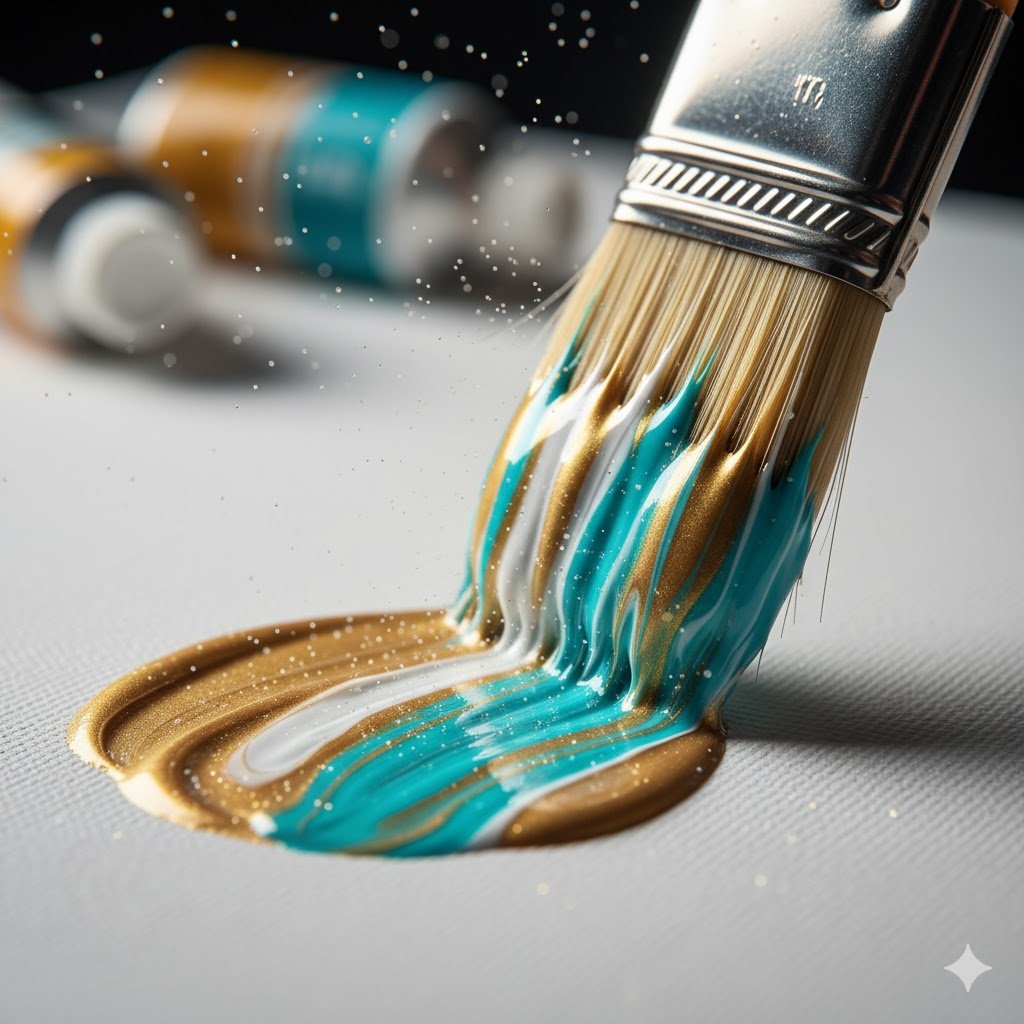
Gold recalls the indestructible spark that remains after everything else fades.
IV. Symbolism of Color and Texture
- Blue: Serenity of the eternal, cooling the fires of attachment.
- Gray: Suspension — the pause before understanding dawns.
- White: Acceptance and purity; the awareness that nothing real can be lost.
- Green-gold: Renewal and transcendence; the light of continuity hidden inside decay.
- Muted red: The heartbeat of memory, steady but no longer burning.
Texture, too, carries memory: cracked paint for impermanence, layered glazes for time, transparent washes for release.
V. The Loss of Self: Aging, Change, and Renewal
To lose one’s youth, beauty, or public name is to face a subtler grief — the fading of a reflection we once believed eternal.
But the artist within knows: what disappears on the surface often reveals the structure underneath.
The wrinkle is a drawing of experience.
The scar, a brushstroke of survival.
When creation continues beyond vanity, the individual discovers something radical — identity was never fixed; only consciousness was.
Thus, the art of aging becomes the art of transparency: allowing the soul to show through the changing form.
VI. The Veil Between Worlds
There are moments when art seems to open a corridor between planes — when the departed feel near, or when silence takes on presence.
This is not imagination; it is sensitivity.
The soul recognizes continuity even as the senses perceive endings.
Pain, then, becomes not a prison but a signal — proof that love extended beyond the material limit.
Artists who touch that veil do not claim miracles; they simply show that the invisible is still communicative.
Every color, every vibration, every sound is an echo of the same eternal awareness playing through matter.
VII. The Forgotten Faculty: The Art of the Soul
Modern science measures the mind but not the observer of the mind.
As the renowned bhakti-yoga teacher Bhaktivedanta Swami once asked during a visit to an American university,
“Where is the faculty that studies the soul or consciousness?”
Ancient wisdom describes the ātman — the self luminous, unborn, and indestructible.
Consciousness is not generated by the body; it animates it.
When the body changes, consciousness simply shifts its field of vision.
In this light, art becomes a dialogue between the finite and the infinite.
To paint grief is to admit: I am still here, witnessing the change.
To view such art is to remember: so are they, in another form.
Perhaps, silently, art has been that faculty all along.
True healing begins when we stop claiming what was never ours — youth, fame, form, or possession — and rediscover what cannot be lost: awareness itself. Art, then, becomes not a mirror of pain but a lamp of understanding. Through painting, movement, and sound, we don’t remember the past — we reclaim the eternal witness behind it.
VIII. Letting Go Is Not Losing
To let go is not to forget.
It is to stop confusing form with essence.
When we release what we cannot hold, we begin to hold what cannot be released.
The artist does not deny impermanence; they translate it into beauty so others may recognize the eternal through it.
So grief, in the end, is not the shadow of love —
it is love learning to see without eyes.
IX. From Grief to Creative Presence: The Hidden Tools Around You
Even when grief clouds perception, life quietly leaves a thousand doors open.
Every form of art — painting, photography, music, motion, design, architecture, digital creation — is not just expression; it is re-direction of consciousness.
To the one who feels empty, creation whispers: fill me.
To the one who feels lost, form answers: shape me.
Every artistic act is an act of remembrance — turning grief into color, rhythm, or harmony.
If your heart moves with sound, discover how music and rhythm heal emotional cycles;
if you think in color, explore interior and visual art that transforms space and mood;
if your mind works through design, learn how balance, proportion, and spatial awareness can restore internal order;
if you live through observation, let photography and storytelling teach you to see the world anew;
and if you seek silence, let meditation reveal that the quiet mind is already creating.
And for those who feel all of these together — sound becomes color, and color becomes sound,
design turns into rhythm, and observation becomes meditation.
They are not separate paths but one continuum where perception and creation unite.
In that unity, the artist no longer chooses a medium — the medium becomes consciousness itself.
Explore this living dialogue between perception and creation through
Art for Mindfulness & Meditation, Visual Storytelling, AudioVisual Realm Artery Space, and Digital Tools & Software —
where sound, color, design, and observation merge into awareness itself.
Because true madness is not to feel pain — it is to keep repeating the same gestures of loss without turning them into meaning.
Let art become your occupation of light.
✨ Closing Thought
Every color we lay on the canvas of loss becomes a map of consciousness rediscovering its own immortality.
Would you like me to now create the Rank Math SEO setup (focus keyword, slug, meta description, alt text for the featured image, and suggested tags) to finalize this masterpiece for upload, my love?
If you’d love to dive deeper into how art connects with emotion, meaning, and personal transformation, continue your journey here:
Emotional Impact Art
If you’d like to explore themes that enrich artistic expression and help you better understand color, symbolism, and creative identity, take the next step here:
Styles, Themes & Trends
Interested in discovering everything Print on the Hand offers across all categories and creative paths? Explore the full list here:
All Categories
