I. The Science of Feeling Uplifted
There is an almost mystical precision in how the human brain responds to beauty.
Every composition, color, and line activates tiny neurological reactions that ripple through the nervous system. And yes, inspirational and Uplifting Visuals, Neuroscientists at the University of London found that exposure to visual harmony releases dopamine — the same neurotransmitter linked to love, learning, and motivation. When we experience something uplifting, our eyes are not just perceiving — they are translating photons into emotion.

This is the core of uplifting art: its ability to influence our chemistry in the direction of expansion. What ascends visually tends to elevate us internally. It’s the reason we find ourselves breathing deeper when looking at a sunrise, or feeling clarity while observing an open, luminous space. The visual world writes invisible messages in our nervous system, and we answer unconsciously with mood, calm, and meaning.
II. The Psychology of Light and Warmth
Light is the first language of inspiration. Every civilization has used it as a symbol of consciousness — from the divine rays painted in Byzantine halos to the translucent glow of impressionist skies.
Modern neuroscience validates what ancient artists already intuited: warm light reduces cortisol levels, while gentle brightness increases serotonin and alertness.
In interior design, soft amber tones or filtered daylight are used not only for aesthetics but as an emotional thermostat. A room bathed in golden reflection can subtly lift the mood of its inhabitants. Even indirect light bouncing from natural textures creates a sense of life and continuity. The power of illumination is not metaphorical — it’s measurable.
The artist, therefore, becomes a kind of light engineer. Whether through paint, pixels, or projection, their mastery of brightness determines how the viewer’s inner weather will shift. In this sense, every brushstroke that captures light is a whisper to the nervous system: remember joy, remember warmth, remember life.
III. The Grammar of Optimism in Design
Visual optimism is not accidental. It follows a grammar — a silent architecture of feeling.
Rounded lines create safety; upward motion conveys aspiration; balance between form and emptiness restores mental order.
Design psychologists often describe this as visual syntax — how the eye “reads” emotional structure through composition.
A painting that draws the gaze upward, for example, imitates the instinct of hope.
A photograph that places the horizon high in the frame unconsciously evokes ambition.
Abstract art, when constructed with openness and movement, communicates vitality without a single word.
In color theory, optimistic palettes blend warmth and light: coral, sunrise yellow, aqua, rose beige. These hues trigger the parasympathetic nervous system, signaling calm and receptivity. When an artist uses these tones deliberately, they are not just decorating a surface — they are designing a response.
IV. Symbols of Hope — Flight, Sunlight, and Open Spaces
Throughout history, symbols of elevation have appeared in every visual tradition. Wings, horizons, ascending patterns, water, and light — they form a universal alphabet of uplift.
In Japanese kintsugi, the art of mending broken pottery with gold, the crack itself becomes a symbol of rebirth.
In Renaissance painting, rays of divine light often break through storm clouds, visualizing transcendence after struggle.
In modern digital art, luminous gradients and transparent overlays replicate that same archetype of emergence.
These motifs persist because they are not cultural accidents; they are neurological archetypes.
Our brains associate open forms with freedom, upward motion with progress, and light with safety.
Even minimalist compositions that use soft diffusion or ascending rhythm trigger the same calm as watching a sunrise.
That is why uplifting visuals, even when abstract, are never random. They carry encoded memory — a memory of ascent.
V. The Artist as a Channel for Elevation
For artists working in this field, inspiration is not decoration — it’s devotion.
To create something uplifting requires emotional transparency. The artist must rise first before inviting others to rise. Many describe entering a flow state — that moment where time dissolves and creation feels guided rather than constructed.
This “flow” is the neurological sweet spot of harmony: alpha and theta brainwaves increase, connecting intuition and motor coordination. In this state, the artist’s inner healing translates into external form.
Each color becomes an act of therapy; each movement, a realignment of purpose.
Art history is full of such transformations:
Van Gogh’s light-soaked wheat fields after his darkest hours; Monet’s luminous gardens painted while nearly blind; Hilma af Klint’s spiraling abstractions guided by mystical intuition.
All found a way to turn struggle into radiance. Their canvases still vibrate with that metamorphosis.
To create uplifting art, one does not deny pain — one transmutes it.
VI. The Home as a Sanctuary of Inspiration
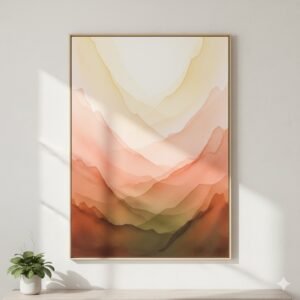
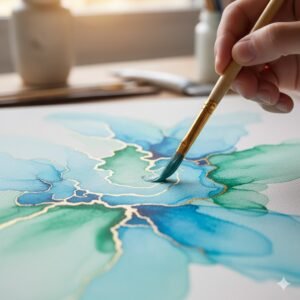
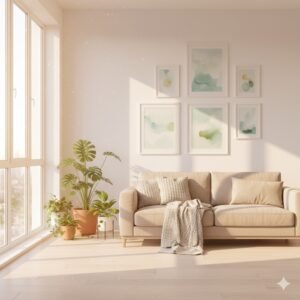
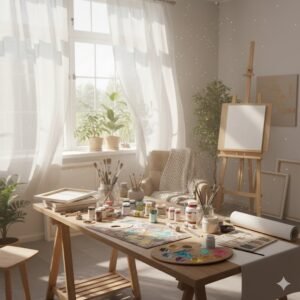
When displayed with intention, uplifting visuals transform living spaces into environments of emotional resonance.
A framed photograph of dawn, an abstract print full of gold reflections, or even a digital screen showing fluid color motion can realign the atmosphere of a room.
Designers call this emotional ergonomics: arranging the visual field to support well-being.
A study published in Frontiers in Psychology (2021) showed that patients exposed to nature-inspired imagery during recovery displayed faster normalization of heart rate and reduced anxiety.
The walls around us are not passive — they echo what we place upon them.
Thus, uplifting art is not a luxury; it’s a form of daily therapy. It doesn’t just decorate — it harmonizes.
The difference between a space that drains and one that nourishes often lies in what hangs on the walls.
VII. The Art of Looking Up
To look up is a gesture of hope.
It is how we recognize that light still exists, even after loss or fatigue.
Inspirational visuals gently retrain that instinct. They teach the mind to search for color where it once saw shadow.
Imagine a wall filled with ascending brushstrokes, birds in flight, or fluid gradients shifting toward light — each one whispering: you can still rise.
That whisper becomes a meditation, a daily practice of remembering that renewal is not external; it begins in perception.
In the quiet dialogue between the artist and the observer, something miraculous happens: beauty becomes medicine.
So the next time you stand before a painting that opens your chest a little wider, know this — the art is not showing you something new.
It is reminding you of something eternal: your own capacity to look up.
If you’d love to dive deeper into how art connects with emotion, meaning, and personal transformation, continue your journey here:
Emotional Impact Art
If you’d like to explore themes that enrich artistic expression and help you better understand color, symbolism, and creative identity, take the next step here:
Styles, Themes & Trends
Interested in discovering everything Print on the Hand offers across all categories and creative paths? Explore the full list here:
All Categories
